Software your businesscan actually run on
From a marketing site that ranks to the system your staff use all day: records, billing, inventory, sales. We build in TypeScript on React, Next.js and Postgres, with access control in the database, tests on the flows that move money, and a handover your own engineers can take over.
- Typical length
- 4–12 weeks
- Best for
- Rebuilds, internal tools and new web products
- Pairs with
- Product design, automation
What's included
Every engagement is scoped from these parts. We'll tell you which ones you actually need — and which you don't.
Architecture
Data model, roles and permissions decided up front and written down before the build starts.
Secure data layer
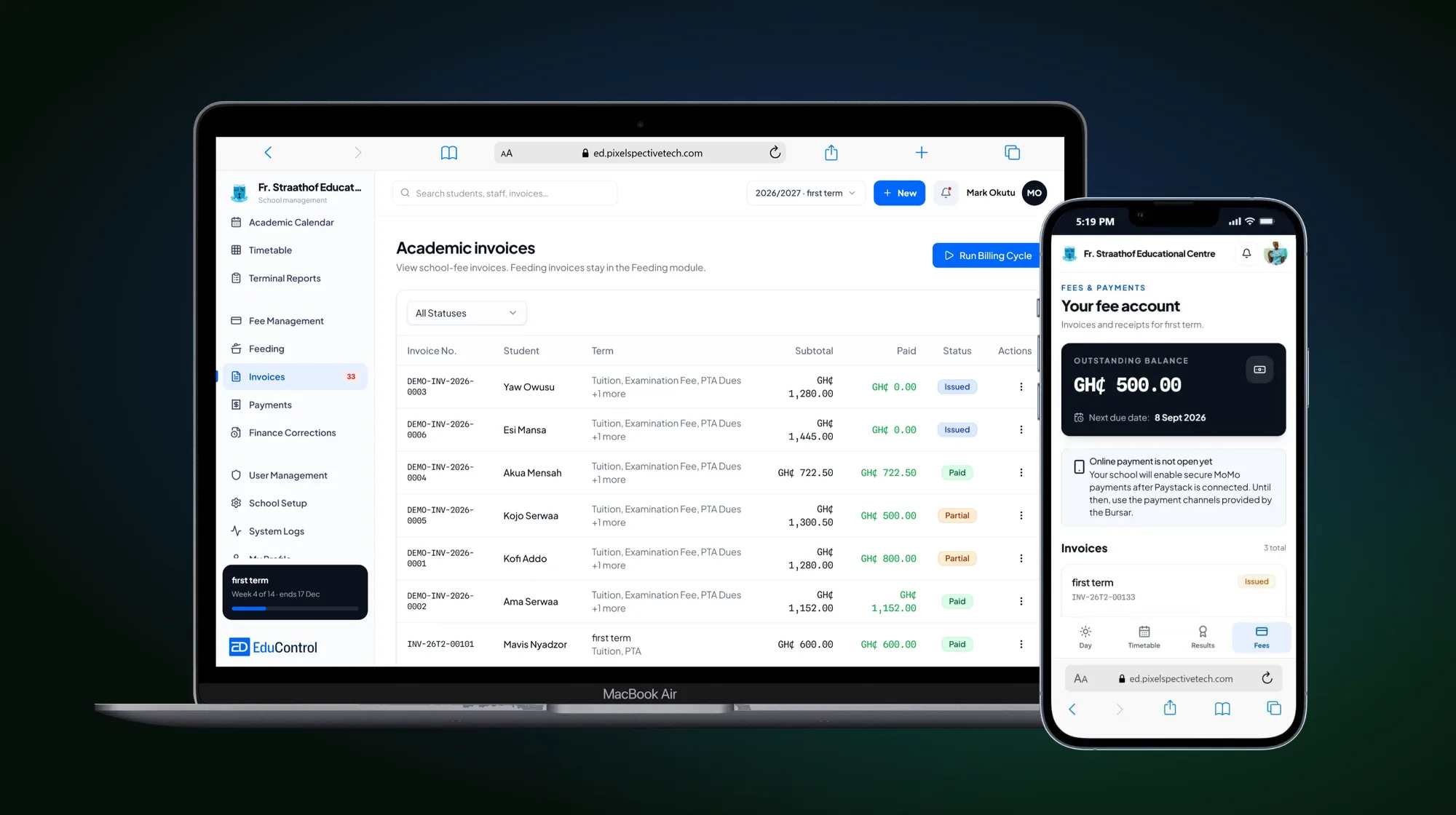
Postgres with row-level security, so each office, school or branch only ever sees its own records.
Payments
Paystack and mobile money checkouts with webhooks, receipts and reconciliation.
Works offline
Installable PWAs that keep taking orders and payments when the connection drops, then sync.
Tests that matter
End-to-end tests on sign-in, payments and approvals, run on every change.
Deploy pipeline
Preview links for every change and one-click production releases on Vercel.
Tools we reach for, and why
The stack is boring on purpose. It has to be maintainable by whoever inherits it, including a team that has never met us.
Next.js + React
Fast pages, good SEO and a huge hiring pool.
TypeScript
Mistakes caught by the compiler instead of your customers.
Supabase / Postgres
One source of truth with auth and row-level security built in.
Vercel
Preview per change, instant rollback, global edge network.
How a project runs
You see working software early and often. Every stage ends with something you can review, not a status update.
- Stage 1
Discovery
We learn your goals, your users and your constraints, and write down what we think the problem is. If we disagree with the brief, you hear it here.
Problem statement and success measures
- Stage 2
Plan
A written plan covering scope, data model, roles and what ships first, with a fixed price for the next phase.
Scope, architecture and quote
- Stage 3
Build
Short design and build cycles. Every week ends with a working version you can click through, not a status update.
Weekly demo on a live preview link
- Stage 4
Launch and grow
We ship, monitor and keep improving — or hand everything over with documentation and a walkthrough for your team.
Production release, docs and handover


Common questions
About web & software development with Pixelspective.
Yes. We start with a short audit, tell you what is worth keeping, and fix the risky parts first. Several of our projects began as half-finished code from another vendor or a no-code tool.
You do, from the first commit. Repositories live in your GitHub organisation and you hold every account.
Yes — Paystack card and mobile money, with webhook verification, receipts and daily reconciliation.
We pick infrastructure that is free or cheap at your size and tell you what it will cost as you grow, before you commit.
Is this the right piece of work?
Send two paragraphs about the problem. We'll reply with how we'd approach it and a rough shape for scope and cost — or point you somewhere better suited.

Every brief is read by Mark Okutu, founder and lead developer, and he replies to each one personally.
Prefer email?
pixelspective1@gmail.com